
Sound Installation: Echoes
The sound installation runs from 12.11.2019 – 05.01.2020 The View Visitor Centre, Chingford, Epping Forest
(FREE - just turn up!) Open 10am-5pm Tuesdays-Sundays
EXTENDED RUN
Moves to High Beach Visitor Centre, Loughton from 16.01.2020 - 01.03.2020
The sound installation runs from 12.11.2019 – 05.01.2020
The View Visitor Centre, Chingford, Epping Forest
(FREE - just turn up!) Open 10am-5pm Tuesdays-Sundays
CDs and posters available to purchase in The View gift shop.
Come and experience my new work Echoes: Unearthing Stories of the Forest as a sound installation in Epping Forest. Just pick up a some headphones and a leaflet from The View Visitor Centre. There’s no correct way to experience this sound installation. You can wander around the museum and stop off at the displays that relate to the tracks, you can take the headphones to the Queen Elizabeth’s Hunting Lodge (opposite The View) or, if you’d prefer, go outside and listen to the music on Chingford Plain.
This collection of new compositions is inspired by the human impact on Epping Forest through the centuries: Iron-Age hillforts, WWII bomb craters that are now ponds, and her ancestor Thomas Willingale – a local labourer who helped save the forest during the 19th century enclosure movement.
A mixture of contemporary classical, folk, and electronica, creating a haunting, textural soundworld that explores themes of lost and fragmented memories, lingering traces of the past and the spirit of place. Echoes includes a self-penned folk song, field recordings, and a graphic score based on a map of Iron-Age Loughton Camp.
This project is linked to the Waltham Forest London Borough of Culture season The People’s Forest, curated by Luke Turner and Kirsteen McNish, and will be a sound installation in Epping Forest.
Guest musicians: Thom Ashworth, Jo Quail (MONO, Poppy Ackroyd), Jay Chakravorty (Bryde, Emma McGrath), Fran Foote (Belinda Kempster & Fran Foote, Stick In the Wheel), and members of The Middlesex Yeomanry Concert Band.


Epping Forest: Sanctuary and Scars
The third in a series of blogs exploring the history of Epping Forest.
Think of a forest, especially at night, and an uneasiness tends to come over you – it might be the fear of getting lost, wild animals, the bogey man. It’s primeval instinct and a horror movie cliché. There’s even a name for it: Nyctohylophobia.
Epping Forest is a sprawling ancient woodland with many legends and folktales attached, but it also has a legacy of providing people with a safe place, of sanctuary and escape.
The Iron-Age Loughton and Ambresbury Camps that I wrote about in a previous blog are believed to be settlements used during times of conflict between neighbouring tribes. Other examples are Londoners who fled to the shelter of the forest during the Great Plague and Great Fire (1665-1666), and Fairmead House in High Beech, a private asylum run by Dr Matthew Allen. Outdoor activities such as working or walking in the forest were among the methods used to treat some of his patients, including the poet John Clare during the mid 1800s.
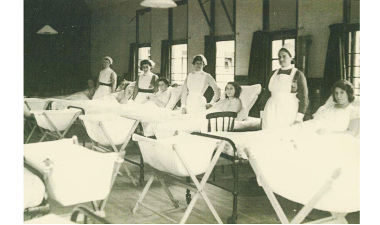
Maternity Ward in High Beech, Epping Forest during WWII
The building that now stands on the asylum plot has always been called Suntrap, and was erected in 1894 for Harold Baring (of the Barings Bank family). It is now a forest education centre for London school kids, which I attended with great excitement during the 1980s. But it was originally a convalescent home for children from the East End with TB, and then during World War II Plaistow hospital moved its maternity ward to High Beech so that East End mothers could give birth in peace and safety. They would travel up a few days before their due date and camp outside until a bed was free. Many families were made homeless or feared for their lives. Some camped in Epping Forest to escape the intensity of bombing on London during the Blitz.

Bomb pond at Fairmead, Epping Forest
The impact of WWII on the forest is still visible today. There are barrage balloon tethers on Wanstead Flats and concrete floors of Nissen huts in High Beech, which housed German and Italian prisoners of war. Although many of the 100 ponds in Epping Forest are gravel pits or ornamental ponds, some are craters formed by V2 bombs. There’s a number of bomb ponds between Fairmead Road (now a forest pathway) and Epping New Road.
Epping Forest hasn’t been an entirely natural landscape since Neolithic times; we’ve created wood pastures and grazed our livestock, built settlements, made a royal forest for hunting, and left the scars of fallen bombs. Whether we tend or destroy, we have been shaping it for centuries.
Interactive map of where bombs fell on London during the Blitz.