New Single: The Lopper and the Landgrabber
From the album and Epping Forest sound installation Echoes: Unearthing Stories of the Forest
The Lopper and the Landgrabber is the first single from my album & sound installation Echoes: Unearthing Stories of the Forest, created during my artistic residency in Epping Forest. The song tells the story of how working-class activism helped save the forest from enclosure during the 19th century.
My main focus for the song is Thomas Willingale, a labourer from Loughton who continued to practise his ancient right of lopping trees in Epping Forest despite strong resistance from the Lord of the Manor. Thomas played an important role in saving Epping Forest and the Willingale story is a wonderful collection of fact and folklore, including court cases, prison sentences and devious plots. There is also a personal connection - he is my 5 x Great Uncle! The folk song’s title takes its name from a William Morris quote. He complained that “the grip of the land grabber is over us all; and commons and heaths of unmatched beauty and wildness have been enclosed for farmers or jerry-built upon by speculators in order to swell the ill-gotten revenues of some covetous aristocrat or greedy money-bag”. The first two verses and first line of the chorus are from poems The Mores and Remembrances by John Clare, who lived for some time at Fairmead House in High Beach, a private asylum run by Dr Matthew Allen. The ‘mind-forg’d manacles’ – a nod to William Blake’s London – are a call to remove the mental chains that restrict those that do not question injustice. You can read more over on my blog here.
I’m joined on this track by Thom Ashworth (vocals, bass, mandolin) and Fran Foote (vocals).
Enclosure came and trampled on the grave
Of labours rights and left the poor a slave
Each little tyrant with his little sign
Shows where man claims earth glows no more divine
It levelled every bush and tree and hill
Hung moles for traitors though the brook runs still
And birds and trees and flowers without a name
All sighed when lawless law’s enclosure came
Enclosure like a Bonaparte let not a thing remain
No rest until it’s torn apart, the landgrabbers’ claim
Old Tom made his living on the land
And at the stroke of midnight made his stand
He lopped a branch from winter’s leafless oak
To save the forest for the Common folk
Back to the inn he entered with the limb
And held it high before the crowd within
No Lord would part him from his ancient right
As he leapt the fence upon St Martin’s Night
The lords and ladies take what’s yours and mine
But lop a branch and you shall do the time
You’ll pick the tarry oakums, tread the mill
For gathering fuel to beat the winter’s chill
Remove those mind-forged manacles and see
The forest’s fate depends on you and me
And beauty all around you’ll never lack
Cos in the end we’ll go and steal it back
Echoes: Unearthing Stories from the Forest is available to order now.
The sound installation runs from 12.11.2019 – 05.01.2020
The View Visitor Centre, Chingford, Epping Forest (FREE - just turn up!)

Epping Forest: Sanctuary and Scars
The third in a series of blogs exploring the history of Epping Forest.
Think of a forest, especially at night, and an uneasiness tends to come over you – it might be the fear of getting lost, wild animals, the bogey man. It’s primeval instinct and a horror movie cliché. There’s even a name for it: Nyctohylophobia.
Epping Forest is a sprawling ancient woodland with many legends and folktales attached, but it also has a legacy of providing people with a safe place, of sanctuary and escape.
The Iron-Age Loughton and Ambresbury Camps that I wrote about in a previous blog are believed to be settlements used during times of conflict between neighbouring tribes. Other examples are Londoners who fled to the shelter of the forest during the Great Plague and Great Fire (1665-1666), and Fairmead House in High Beech, a private asylum run by Dr Matthew Allen. Outdoor activities such as working or walking in the forest were among the methods used to treat some of his patients, including the poet John Clare during the mid 1800s.
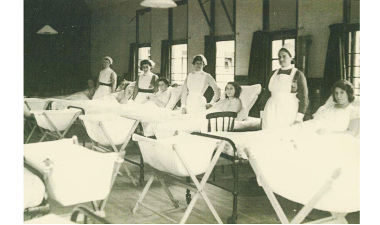
Maternity Ward in High Beech, Epping Forest during WWII
The building that now stands on the asylum plot has always been called Suntrap, and was erected in 1894 for Harold Baring (of the Barings Bank family). It is now a forest education centre for London school kids, which I attended with great excitement during the 1980s. But it was originally a convalescent home for children from the East End with TB, and then during World War II Plaistow hospital moved its maternity ward to High Beech so that East End mothers could give birth in peace and safety. They would travel up a few days before their due date and camp outside until a bed was free. Many families were made homeless or feared for their lives. Some camped in Epping Forest to escape the intensity of bombing on London during the Blitz.

Bomb pond at Fairmead, Epping Forest
The impact of WWII on the forest is still visible today. There are barrage balloon tethers on Wanstead Flats and concrete floors of Nissen huts in High Beech, which housed German and Italian prisoners of war. Although many of the 100 ponds in Epping Forest are gravel pits or ornamental ponds, some are craters formed by V2 bombs. There’s a number of bomb ponds between Fairmead Road (now a forest pathway) and Epping New Road.
Epping Forest hasn’t been an entirely natural landscape since Neolithic times; we’ve created wood pastures and grazed our livestock, built settlements, made a royal forest for hunting, and left the scars of fallen bombs. Whether we tend or destroy, we have been shaping it for centuries.
Interactive map of where bombs fell on London during the Blitz.