New Release
BBC Radio 3 live recording released on NMC Recordings

‘Ellie Wilson’s haunting Moth x Human turned data about night-time moth activity into a beguiling synthesised fabric’ The Guardian ★★★★
‘So beautiful. Haunting’ CBC Radio
‘A moth symphony … each species has its own distinct musical sound’ Scott Simon, NPR
BBC Radio 3 live recording from PRS Foundation’s New Music Biennial out now on NMC Recordings
Ellie Wilson writes … As biodiversity declines globally, the quiet disappearance of insects often goes unnoticed. I wanted to compose a piece that not only reflected this loss, but also allowed the insects themselves —specifically moths — to help create it, resulting in a sort of interspecies dialogue between moths and humans.
I don’t think I realised quite how much time would be spent staring at spreadsheets before I could start making music. I was introduced to scientists at the UKCEH who use an automated, solar-powered device that records moth activity overnight. It has a light source to attract moths, a camera to photograph them and a computer plus AI to identify the species and timestamp each visit.
I selected a single evening of data and transformed it into music. A custom-built Max/MSP device let me bring this data into Ableton. Each moth’s visit was converted into MIDI, with species assigned a unique pitch or timbre. I condensed real-time monitoring of a whole evening into the 12-minute duration of the work, capturing the ebb and flow of moth activity throughout the night. At some points the moths have created short melodic fragments, and these can be heard later in the piece as repeating motifs in the cello and piano.
The piece sonically represents the impact of biodiversity decline by using data from the same evening but two contrasting locations. It opens with data gathered from Parsonage Downs in Wiltshire, a healthy chalk grassland habitat. Over the course of four hours, 80 different moth species were recorded. The sound world is rich, very active, demonstrating a thriving ecosystem. The closing section of the piece uses data from a monoculture farm in Cambridgeshire where pesticides are used. Here, only 19 moth species were recorded during the same four-hour period and the soundscape is noticeably more sparse and monotonous.
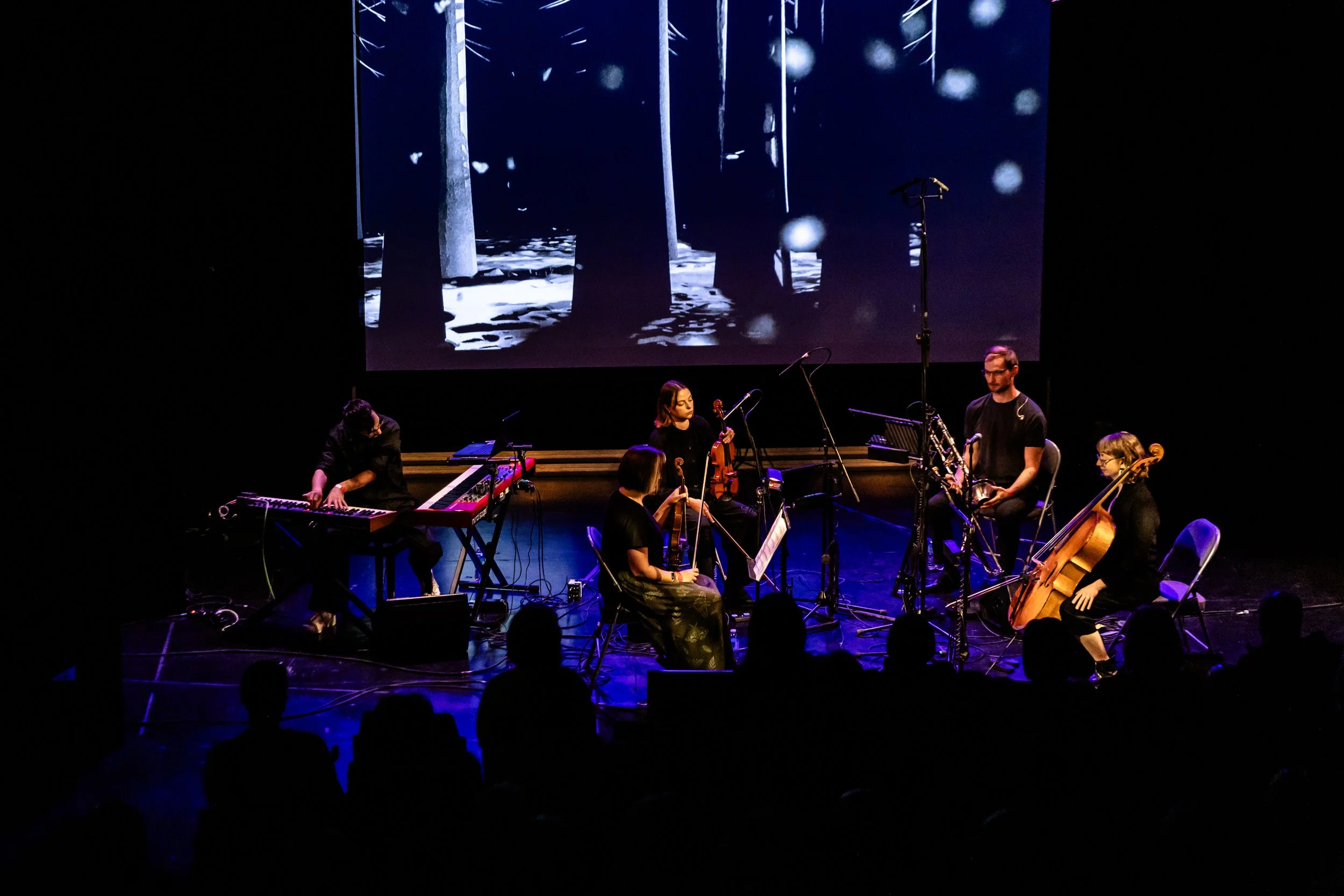
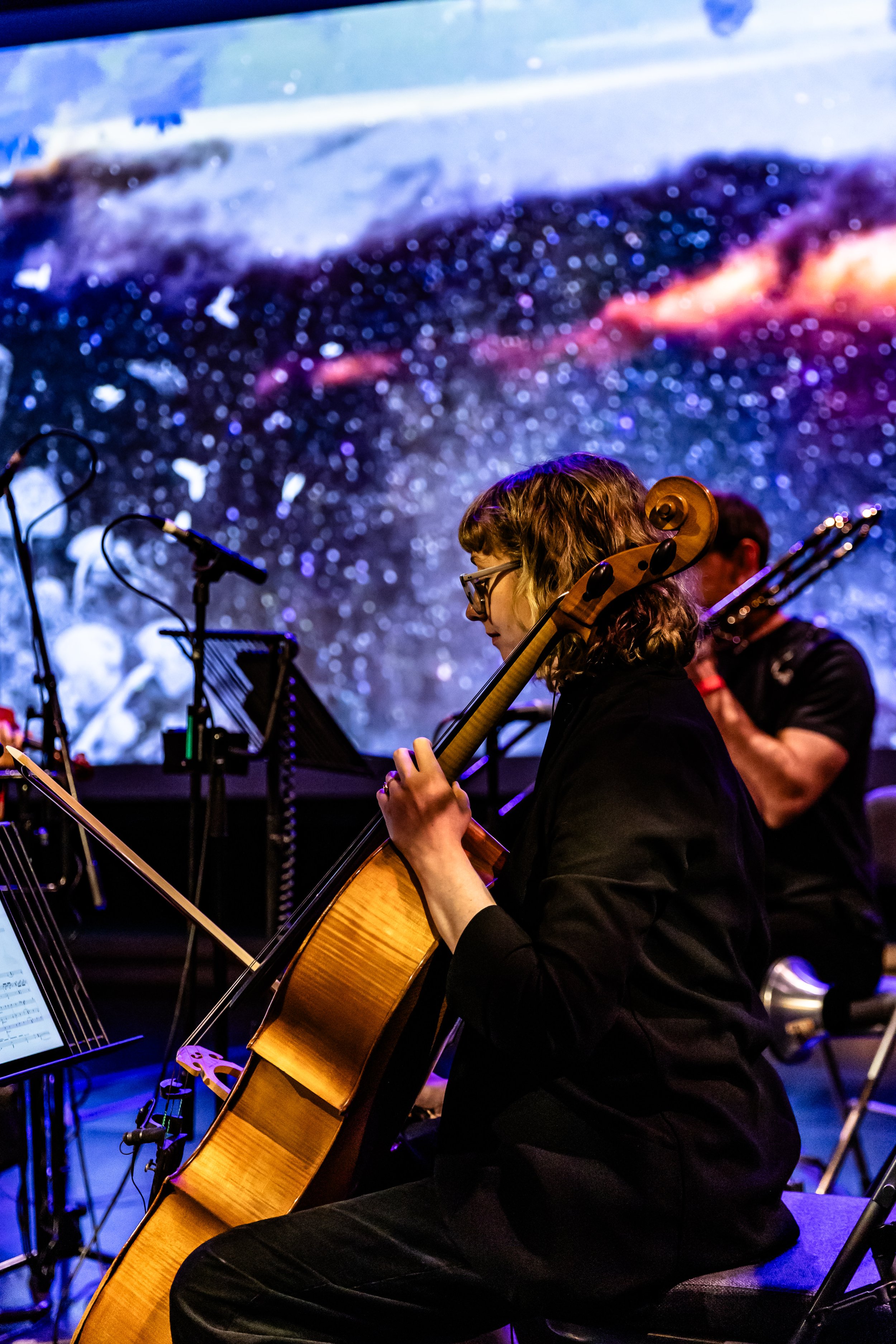
Moth x Human is scored for 2 violins, cello, trombone, piano and analogue synthesizer, but at the heart of the piece is the fixed media track built from the moth data, which plays alongside the live instruments. Most of the writing for the two violins is delicate (marked ‘gossamer – like moth wings’ in the score). They move in fast, whispered exchanged with lots of string crossing that moves from flautando to sul ponticello to bring out a wide range of overtones and timbres. This creates a sort of dreamy, fluttering soundworld. The cello brings contrast and character: playful pizzicati, glissandi, Bartók snaps, and even percussive tapping on the body of the instrument mimic the frantic flutter of a moth caught in a lampshade. I was very lucky to work with The Northern School of Art, who even designed a new module around my project. Fine art, animation, and photography students all created moth inspired artwork that was then 3D animated to make the visuals that are used in the live performance.

Moth x Human Bradford World Premiere
New Music Biennial premiere of Moth x Human at Bradford Loading Bay




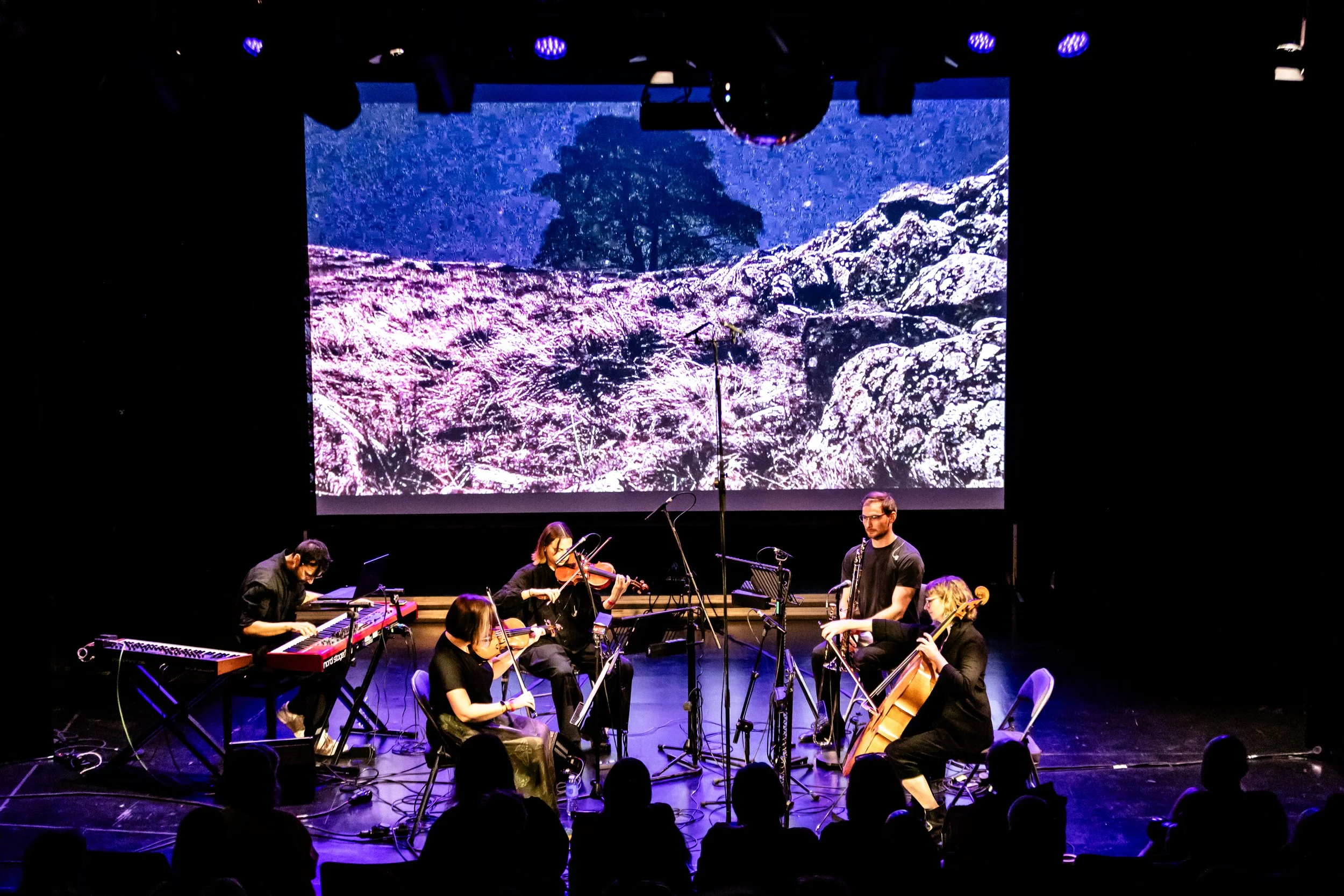


Team Moth
Ellie Wilson violin
Freya Hicks violin
Louise McMonagle cello
Huw Evans trombone
Jay Chakravorty piano/synths
Visuals: The Northern School of Art
Photos: Victor Frankowski taken at New Music Biennial, Loading Bay Theatre, Bradford, Saturday 7 June 2025
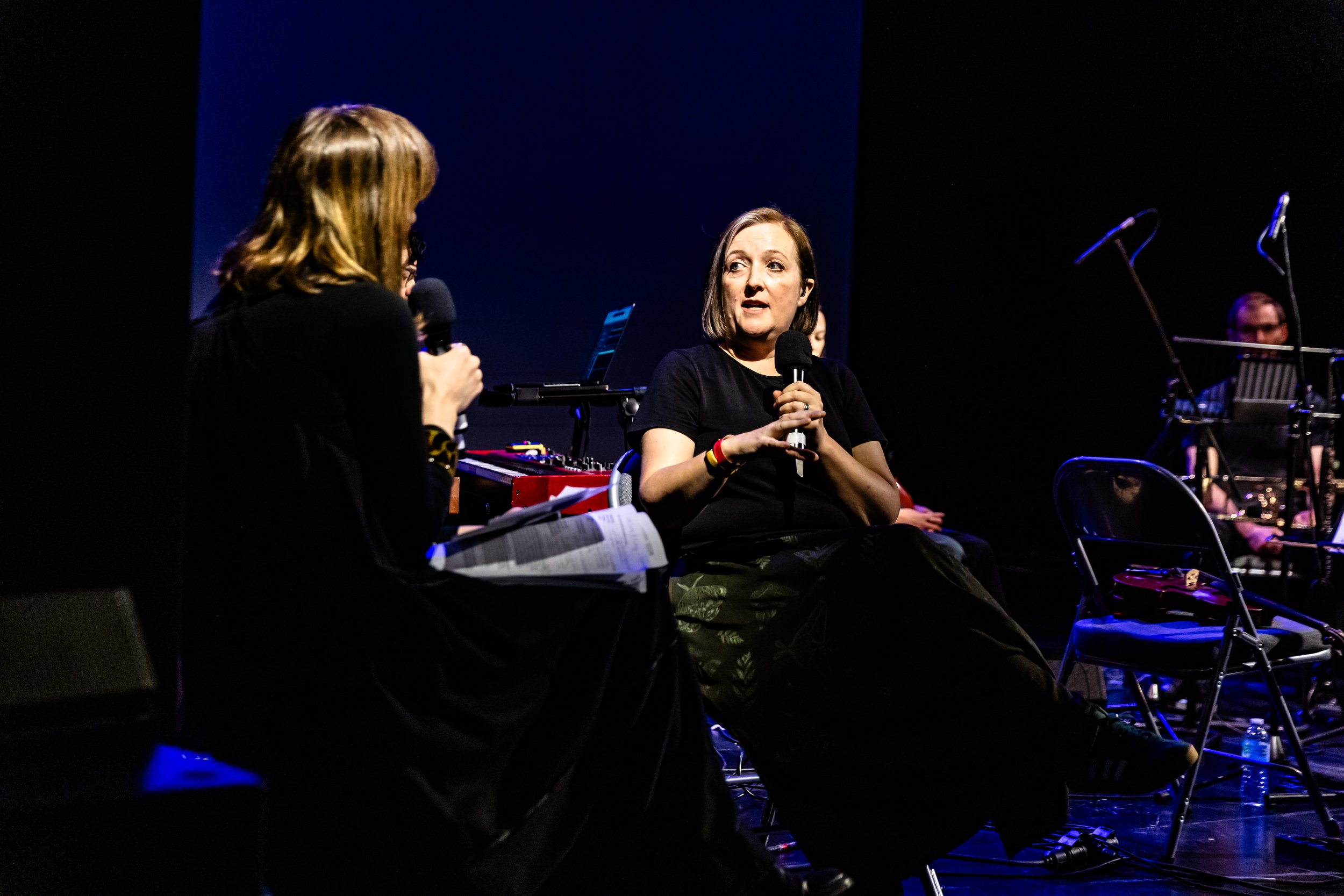
interviewed by Elizabeth Alker for BBC Radio 3 New Music Show
Moth x Human is commissioned by Oxford Contemporary Music and supported by UK Centre for Ecology and Hydrology
New Music Biennial 2025 – PRS Foundation and Southbank Centre’s new music festival in partnership with Bradford 2025 UK City of Culture and BBC Radio 3 and NMC Recordings.

New Music Biennial
New commission exploring moth biodiversity selected as part of PRSF’s New Music Biennial
I’m delighted that my new work Moth X Human has been selected for PRSF New Music Biennial 2025. Environmental and biodiversity issues are something I’m passionate about and this piece will highlight the impact that habitat loss, climate change and light pollution has on our nocturnal pollinators.
In collaboration with biodiversity scientists at the Centre for Ecology and Hydrology, my piece explores the positive use of AI for conservation. Part data sonification, part notated composition, the work is an interspecies dialogue. Alongside a small ensemble and electronics, moth activity data collected from UK locations is used to generate and manipulate sounds.
Dr Jenna Lawson of UKCEH, said:
“At a time of rapid biodiversity loss and climate change, it is essential that we understand and appreciate the value of nature and the consequences of habitat loss and destruction. The data we collect as scientists highlights both the remarkable diversity of nature and consequences of its loss, however the challenge often lies in presenting this information in an interesting and informative way.
“This project will showcase the wonder of nature through music, specifically focusing on moths and the natural world that comes awake while we sleep. These fascinating creatures are essential for our ecosystems, pollinating many flowers, trees and crops during the night, but are underappreciated. We hope Ellie’s interpretation of our scientific data through a musical composition will show people the remarkable night-time biodiversity of the UK.”
The piece will be performed at the two festival weekends:
6-8 June 2025 Bradford City of Culture
4-6 July South Bank Centre
Broadcast on BBC Radio 3 and released on NMC Recordings.
Commissioned by Oxford Contemporary Music
Supported by UK Centre for Ecology and Hydrology (UKCEH)
